


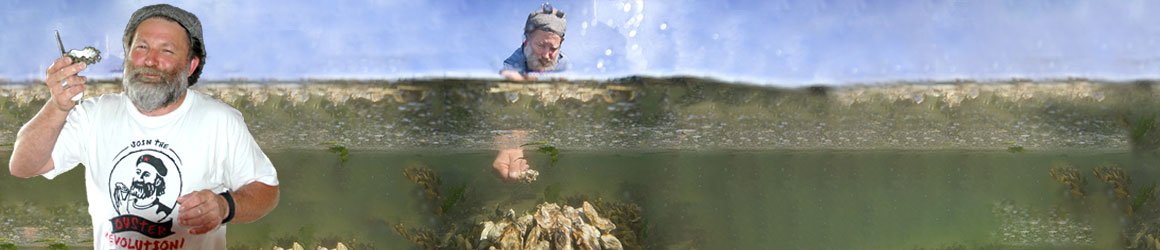
The Shell Game
 Written by: Dee Hobsbawn Smith Published by: Swerve Magazine (04/29/05)
The transition from hand to mouth, from living to lunch, became too much for one oyster lover.
I met the most famous bivalve the summer we lived like Gypsies. We were already used to packing up and moving every year or two from air force base to air force base. This time, when we arrived on Vancouver Island from northern Alberta, our parents pitched a tent on Kin Beach, outside of Comox, while we awaited our new house. For five kids, it was paradise. The tent was snugged in a quiet little dell, fronted by a stand of Douglas firs, behind the high-tide driftwood and the blanket of kelp that washed up against the logs. Digging through the damp seaweed, avoiding washed-up starfish and sand dollars and scuttling tiny crabs to extricate a piece of bull kelp was an act of bravery for new coastal dwellers. Chasing brothers, snapping the kelp like a whip, was pure pleasure. I met the most famous bivalve the summer we lived like Gypsies. We were already used to packing up and moving every year or two from air force base to air force base. This time, when we arrived on Vancouver Island from northern Alberta, our parents pitched a tent on Kin Beach, outside of Comox, while we awaited our new house. For five kids, it was paradise. The tent was snugged in a quiet little dell, fronted by a stand of Douglas firs, behind the high-tide driftwood and the blanket of kelp that washed up against the logs. Digging through the damp seaweed, avoiding washed-up starfish and sand dollars and scuttling tiny crabs to extricate a piece of bull kelp was an act of bravery for new coastal dwellers. Chasing brothers, snapping the kelp like a whip, was pure pleasure.
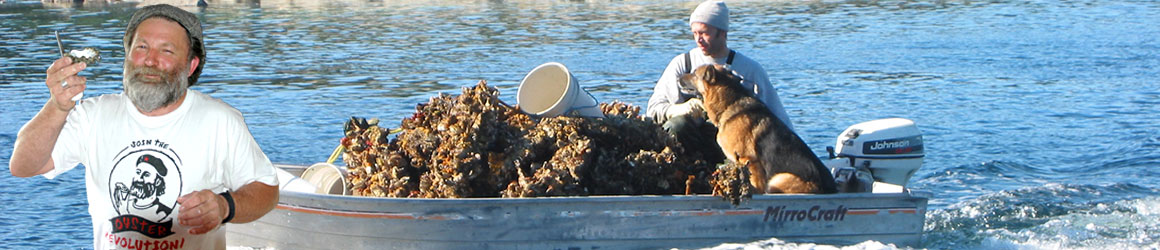
It was high summer. Above us, on the escarpment at nearby Point Holmes, Voodoo jets screamed into the base, but we were too busy with shell games to notice. At low tide, we swarmed across the slick rocks and stones, filling our buckets with oysters, wet and ridged layers of calcified time, moon-glow alabaster shells. The buckets wobbled beneath outstretched arms as we leapt from log to log, back to the beach fire that waited for us. Pitching the oysters in a heap, back to the beach for clams, shovels in hand, waiting for the betraying squirts of water that showed the hidden treasure beneath the sand. Digging clams was a mug's game. No sooner would we put shovel to sand and flail down a few inches than we'd spot another squirt a few feet away, and in looking away, lose track of the current prize beneath the blade of the shovel. Run to the new squirt, dig down quickly to locate the clam. When the bucket was finally full of sand-jacketed clams, we sluiced them with seawater and draped handfuls of damp seaweed on top. For sound effects, we stomped the fattest rackweed we could find.
|
Awww, Shucks...
OYSTERS ROCKY
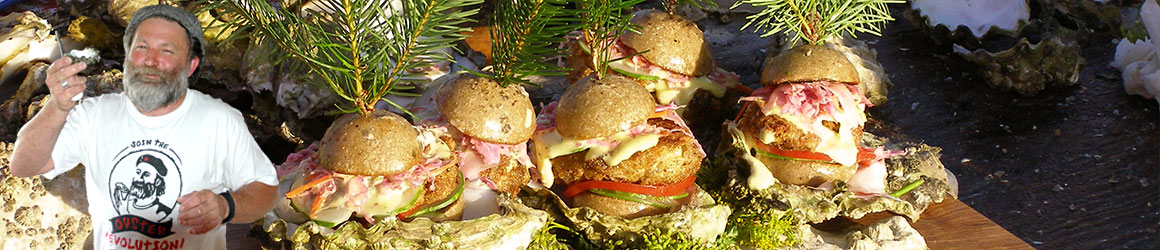
This comes from a time when oysters and butter were indications you had made it to the big time. Make the compound butter In advance, shape into small logs, wrap and freeze until needed. Serve with champagne, Sancerre, Grand Cru Chablis, Pouilly Fume or apple beer Serves six as a starter. YOU NEED 24 OYSTERS IN THE SHELL, AND ROCK OR KOSHER SALT FOR THE TRAY.COMPOUND BUTTER
SPICY FRIED OYSTERS
This is simple enough for cooking on the beach with a fire and a cast-iron pan. Serve with wedges of lemon, cold beer or champagne. Serves two to four.
|
It rained oysters that summer. We ate stew by the gallon, briny-sweet and cloying, scented by the sea and the sea breeze as it blew in off the beach. Every night, we steamed oysters open on the fire, heaps of discarded shells attracting the gulls. Finally, I couldn't countenance another. No stew. Not one more raw or steamed or broiled or baked. Couldn't abide the smooth texture, the slick feel as it went from hand to mouth, from living to lunch. I was seven. I gave up oysters for good. Or at least for decades.
Decades, and a new city, a thousand hours inland. It was in Calgary that I discovered I could again face down an oyster without flinching, that I could pick up an oyster knife and pry open the shell without the aroma of my mom's stew infiltrating my nostrils. At Catch, I met a plateful of jewel-like Kumomotos, tiny and conical, sweet and cucumber-scented. Then, at Big Fish, I essayed a dozen Caraquettes, smooth-shelled, mild-mannered East Coasters. (But God save me, I still can't eat my mom's oyster stew.)
A month later, I was back on the West Coast, on an oyster beach along the coast of Cortes Island, just off Desolation Sound. On the ferry across from Quadra Island, I stared at the map, a squiggling hieroglyphic of sounds and inlets and ocean depths, then sketched it in my journal. X marked the spot where I found Brent Petkau waiting on his beach with his oysters and his oyster knife.
Finally, a few glistening Royal Courtesans, the ruffled and layered shells of my childhood, lay in front of me. My years of abstinence were ended. Somehow, oysters taste better on the beach.


